
Conservatory Extension Cost in the UK: 2026 Price Guide
Most UK conservatories cost between roughly £8,000 and £40,000 to build, and the final figure depends far more on the frame material, roof and finish than on size alone. The Federation of Master Builders (FMB), the trade body for UK builders, lists a lean-to uPVC conservatory at £8,000 to £17,000, and a mid-range aluminium one at £20,000 to £40,000. A bespoke timber build starts from £45,000. This guide shows what sits behind those numbers, which extras get missed, and how to compare quotes so the price you sign is the price you pay.
TL;DR
- Typical 2026 build prices: £8,000 to £17,000 for a lean-to uPVC, £20,000 to £40,000 for mid-range aluminium, and from £45,000 for bespoke timber.
- Per square metre, expect about £1,800 to £2,400 for a basic uPVC lean-to, £2,200 to £2,800 for a Victorian or Edwardian shape, and £3,500 to £4,200 for oak frame.
- Budget for the extras: groundwork, electrics, heating, decoration, Building Control fees, VAT and a contingency of at least 10%.
- Most conservatories avoid planning permission and building regulations only if they meet specific conditions, so check those before you design.
- Compare at least three written quotes on exactly the same scope.
Table of Contents
- What a conservatory costs by type
- Cost per square metre
- What pushes the price up or down
- The extras that catch people out
- Do you need planning permission or building regulations approval?
- Conservatory or extension: where the money goes
- How to compare conservatory quotes
- Where we come in
- Our view on getting a conservatory budget right
- FAQ
- Sources
What a conservatory costs by type
The FMB’s cost guide, last updated in June 2026, prices each type on a complete build: roof, floor, glazing, plastering, electrics and internal finishes. That matters, because a number quoted for “the conservatory” often covers only the frame and glass.
| Type | FMB price range (2026) |
|---|---|
| Lean-to uPVC | £8,000 to £17,000 |
| Basic uPVC | £10,000 to £15,000 |
| Mid-range aluminium | £20,000 to £40,000 |
| Bespoke timber | From £45,000 |
The wide spread inside each row is real. Size, access to the back garden, ground conditions and the standard of finish all move the total. A lean-to is the simplest shape, with a single sloping roof against the house wall, which is why it sits at the cheaper end. Shapes with more corners and a more complex roof cost more to glaze, frame and weatherproof.
Cost per square metre
Per square metre figures help you sense-check a quote. Homebuilding’s 2026 extension cost guide gives these rates:
- £1,800 to £2,400 per m² for a basic uPVC lean-to conservatory
- £2,200 to £2,800 per m² for complex Victorian, Edwardian, L-, P- and T-shapes
- £3,500 to £4,200 per m² for an oak frame
- A premium of 25% to 35% in London and the South East
A worked example
Take a 12 m² uPVC lean-to, roughly 4m by 3m. At £1,800 to £2,400 per m², the build comes to £21,600 to £28,800. A 15 m² Edwardian-style conservatory at £2,200 to £2,800 per m² lands between £33,000 and £42,000. Oak is a different category: Oakwrights’ James Underwood, quoted in the same Homebuilding guide, says a realistic figure for a 20 m² oak frame conservatory is £3,500 per m² plus VAT upwards, which means £70,000 before VAT.
The per m² rate usually falls as the building gets larger, because design and manufacturing costs are spread over more floor area. A small conservatory can therefore look expensive per metre even when the total is modest.
What pushes the price up or down
Frame material. uPVC is the budget option, aluminium sits in the middle, and timber and oak are at the top. The FMB table above shows how steeply the ranges climb.
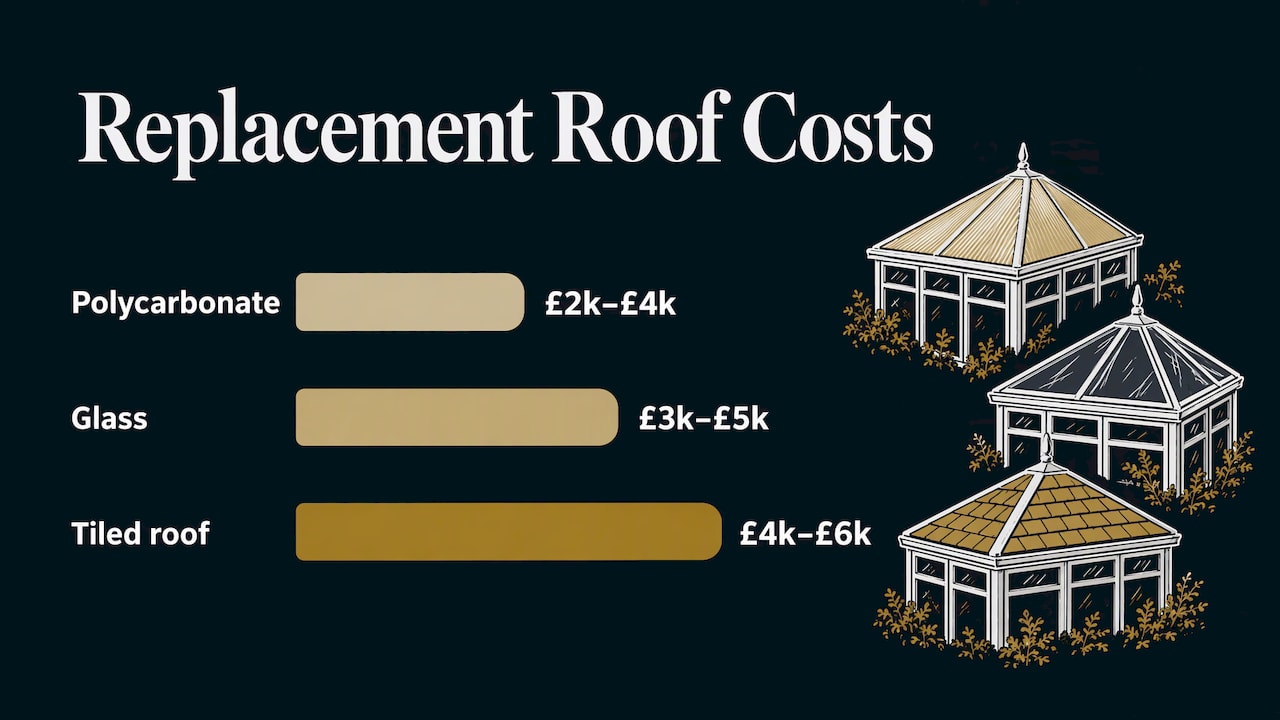
Roof type. Glass, polycarbonate and tiled roofs all behave differently on price and on comfort. The FMB gives replacement roof prices for existing conservatories of £2,000 to £4,000 for polycarbonate, £3,000 to £5,000 for glass and £4,000 to £6,000 for a tiled roof. A tiled or warm roof costs more but makes the room usable through the year. If you already have a conservatory with a tired roof, our guide to conservatory roof replacement options, costs and rules covers that route in detail.
Shape and size. Every extra corner means more framing, more glazing and a more complicated roof junction.
Site conditions. Sloping ground, poor access for materials and the need for deeper foundations all add labour. A conservatory built on a poor base will cost you later, so the existing structure should be checked before you choose finishes.
Finish. Plastered walls, a proper floor, electrics and decoration are part of a complete room. A quote that leaves them out will look cheaper and then grow.
The extras that catch people out
The FMB advises budgeting for skip hire, electrics, decoration, Building Control fees, structural engineering advice and VAT. Homebuilding adds the cost of knocking through into the existing house and making good the connection, plus rewiring, redecorating, insulation, new doors and windows, temporary kitchen facilities if the work affects your kitchen, garden landscaping afterwards, and new furniture.
A practical way to handle this is a short list you check against every quote:
- Groundwork and foundations, including removing any old base
- Roof, glazing and frame
- Opening up the house wall and making good
- Electrics, heating and insulation
- Plastering, flooring and decoration
- Waste removal and skip hire
- Building Control or inspector fees, where they apply
- VAT
- Landscaping around the finished building
On top of the total, the FMB recommends a contingency of at least 10%. On a £25,000 build that is £2,500 set aside for surprises, which are most common once the ground is opened up.
Do you need planning permission or building regulations approval?
The answer changes the cost, so settle it early. Which? (July 2026) says planning permission is usually needed if:
- the home is in a conservation area, national park or Area of Outstanding Natural Beauty
- the conservatory is not at ground level
- the home is terraced or has already been extended
- the home’s volume would increase by more than 15% or 70 cubic metres, whichever is greater
It also notes that planning approval takes around eight weeks, which is worth building into your timeline.
Building regulations are separate. A conservatory is normally exempt when it:
- is separated from the house by an external door
- is under 30 m²
- is single storey at ground level
- is glazed to building regulations and British Standards
- is not within 1m of a boundary
- has at least 75% of the roof and 50% of the walls glazed
If the exemption does not apply, the work must be checked by your local authority or a privately appointed approved inspector, and that inspection is a cost to include. Even an exempt conservatory still has to be safe, so electrical work and heating need to be done properly. Work near a shared boundary can also raise party wall agreement questions with your neighbour, so it is sensible to raise it with your contractor at the design stage.
Because conservation areas and local authority rules differ, ask your local council’s planning department to confirm your own property’s position before you commit.
Conservatory or extension: where the money goes
A conservatory is often assumed to be the cheaper route. The comparison is closer than it looks. The FMB puts a replacement single-storey extension at £1,000 to £2,500 per m² excluding VAT, which overlaps with the lower per m² rates for a conservatory.
The difference is what you get. A conservatory is glazed, and in summer and winter it behaves like it. A solid-roofed extension is built to the same standard as the rest of the house and can be used as a kitchen, dining room or playroom all year. If the room is meant to be a permanent part of the house, pricing a full extension next to a conservatory is worthwhile. Our single storey extension cost guide sets out those figures.
How to compare conservatory quotes
The FMB recommends at least three written quotes on the same scope of work. That phrase is the whole discipline: if one quote includes plastering and electrics and another does not, the cheaper number is not cheaper.
When the quotes arrive, check each one for:
- What is in the price: labour, materials, groundwork and preparation, disposal, and design and planning work
- What is excluded: skip hire, access equipment, travel and extra preparation
- VAT and Building Control fees: included or added on top
- Insulation, plastering, structural checks and waste removal: a very low quote that leaves these out is the usual warning sign
- Warranty and guarantee terms: in writing, with the work described
Ask for everything in writing so the scope is fixed before work starts, and keep your 10% contingency separate from the quoted price.
Where we come in
We build conservatories and extensions for homes and commercial properties, and we give free written estimates so you can see what is included before you decide. Our work is fully guaranteed and backed by extensive warranties, and we manage the project from start to finish, so the groundwork, the roof, the glazing and the finish are coordinated by one team rather than by you chasing several trades.
See our conservatories and warm roof conversions page, or the wider groundwork services page for conservatory and landscaping work. We cover Wiltshire, Worcestershire, Chester, Newport, Cardiff and Swindon.

If you are weighing a conservatory against a full extension, our extensions page shows how we run a project from planning to finish.
Our view on getting a conservatory budget right
Most budgets go wrong before a single brick is laid, because the quote and the finished room are two different things. The frame and glass are the visible part. The groundwork, the roof junction with the house, the electrics and the finish are what make the room comfortable, and they are where careless pricing hides.
Our approach is to define the whole job in writing first. The roof, the floor, the connection to the house and the finish are all described in one free written estimate, so you can compare like with like and see the real total.
We think a conservatory should be built as a lasting part of the home. That is why our work is fully guaranteed and carries extensive warranties, and why we manage every stage ourselves: when one team is accountable for the whole build, the details that cause problems later get dealt with at the start.
Trey
FAQ
How much does the average conservatory cost in the UK?
According to the FMB’s 2026 guide, a basic uPVC conservatory costs £10,000 to £15,000, and a mid-range aluminium one £20,000 to £40,000. Your own figure depends on size, roof, finish and site conditions, so a written estimate for your property is the reliable number.
Do I need planning permission for a conservatory?
Often you do not, but you do in a conservation area, national park or AONB, on a terraced or already extended home, or if the volume increase exceeds 15% or 70 cubic metres. Which? says approval takes around eight weeks. Check your own property with your local council.
Is a conservatory cheaper than an extension?
Not always. The FMB prices a replacement single-storey extension at £1,000 to £2,500 per m² excluding VAT, which overlaps with conservative conservatory rates. The difference is that an extension is built to full house standard and suits year-round use.
What should I add on top of the quoted price?
The FMB recommends a contingency of at least 10%. Also check that VAT and Building Control fees are included, and allow for decoration, furniture and landscaping after the build.
Sources
- FMB: Conservatory costs, roof replacement costs, upgrades and extensions
- Homebuilding: How much does an extension cost in 2026?
- Which?: How much does a conservatory cost in the UK?