Commercial Roof Inspection: What It Covers and When to Book
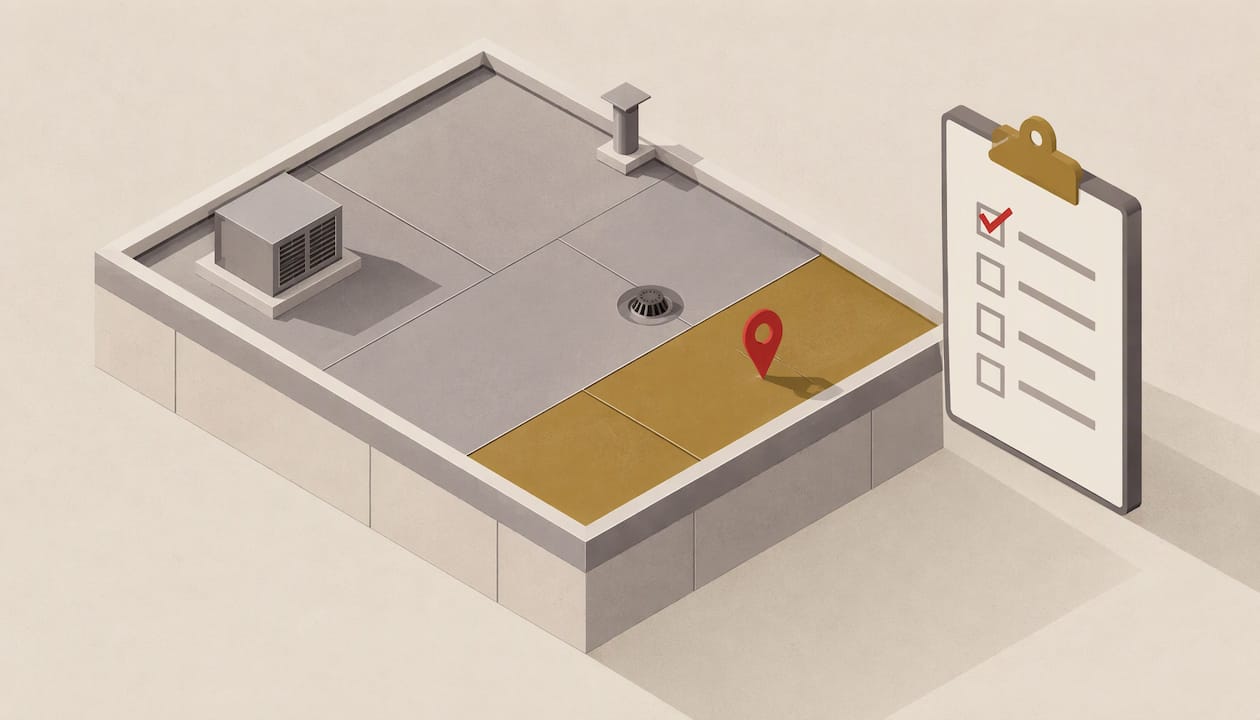
A commercial roof inspection is a structured check of the whole roof system, not just the surface you can see from a ladder. It covers the waterproof layer, the details around it, the drainage, the insulation and the deck underneath, and it ends in a written report that tells you what is wrong, how urgent it is and roughly what it will cost to put right. Done well, it turns roof spending from a string of emergency call-outs into a plan. We are Yellowstone Roofing and Property Contractors, and we repair, maintain and replace roofs for commercial and residential clients, so the guide below is written from the point of view of someone who has to act on the findings.
TL;DR
- An inspection or survey should assess the waterproofing, insulation, deck and supports, plus flashings, drainage and rooflights, and end in a written report with priorities and costs.
- Visual checks are the starting point. Moisture mapping, thermal imaging or core samples are added where the roof’s condition or build-up needs proof.
- Book one before buying or leasing a building, when a roof is ageing, after severe weather, and as part of a planned maintenance programme.
- A clear scope matters more than the label on the quote: decide what is covered, what access is needed and who owns which part of the building.
- Findings are only useful if the same team can price and carry out the repair. Our estimates are free and written.
Table of Contents
- Inspection or survey: is there a difference?
- What a commercial roof inspection covers
- How the inspection is carried out
- Common defects a survey picks up
- What the report should contain
- When to arrange one
- Scope, cost and what moves the price
- From findings to a maintenance plan
- Getting a written estimate from us
- FAQ
- Sources
Inspection or survey: is there a difference?
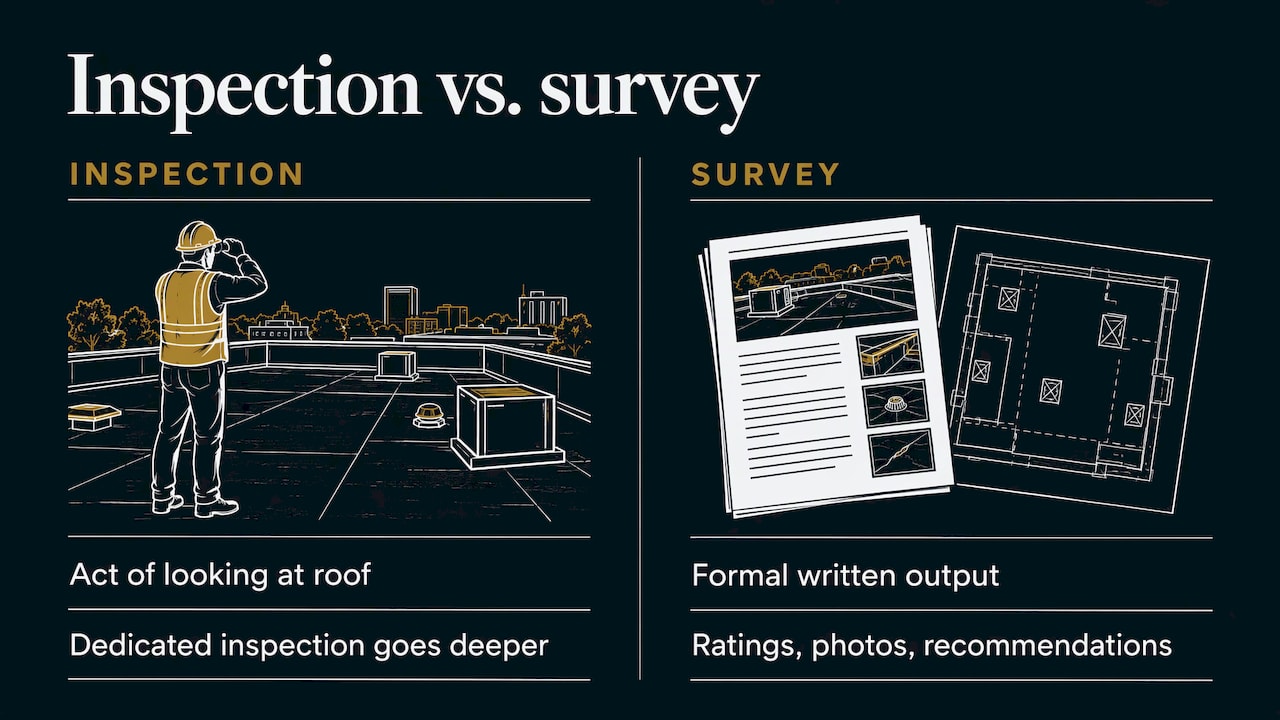
In everyday use the two words overlap, and people searching for a commercial roof survey usually want the same thing as those searching for an inspection. Broadly, an inspection is the act of looking at the roof, while a survey is the formal, written output of that looking, with ratings, photographs and recommendations. When you ask for a quote, ask what the deliverable is. A quick walk-over with a few photos is not the same as a report you can budget from or hand to a lender, a landlord or an insurer.
The Royal Institution of Chartered Surveyors (RICS), the professional body for surveyors in the UK, publishes standards for two related kinds of commercial building survey. One is planned preventative maintenance (PPM) surveys, which cover instruction, preparation, the inspection itself and the report, including a maintenance schedule and cost data. The other is technical due diligence, used when a commercial property is being bought or leased. In both, the roof is one element among many, and the standard lists it first, alongside canopies and balconies.
For a property manager the practical point is this: a whole-building survey treats the roof as one line in a long list. A dedicated roof inspection goes deeper on the one element that lets water into everything else.
What a commercial roof inspection covers
A thorough inspection works from the top surface down and from the edges inward. The checklist below reflects what professional guidance and published survey examples describe.
The waterproofing layer
Whatever the roof is made of, the surveyor is looking for splits, punctures, blistering, open laps and seams, loss of surface protection and areas where water sits instead of draining. On flat roofs, ponding water is one of the first things to be noted, because standing water ages the surface faster and points to falls (the slope that carries water to the outlets) that are not working. Flat systems such as EPDM (a synthetic rubber sheet), GRP (glass-reinforced plastic) and torch-on felt each fail in their own way, so the material needs to be identified correctly first.
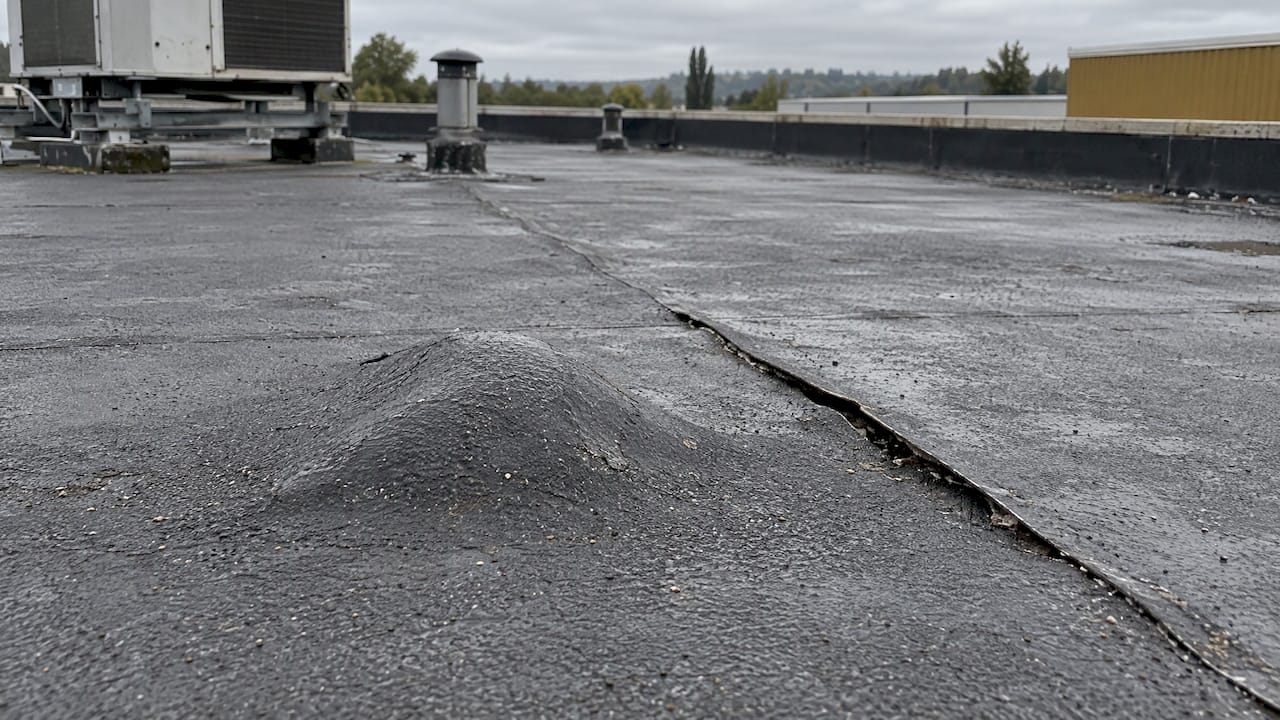
That is harder than it sounds. The Liquid Roofing and Waterproofing Association’s design guide for specifiers warns that not all profiled sheeting is fibre cement, since it can be coated steel, aluminium or composite. It also notes that black material is not always asphalt, because it may be bituminous felt or a polymeric single-ply membrane, and that flat metal sheet is not always lead. A wrong identification leads to the wrong repair, so this step sits at the start of any sound report.
Flashings, upstands and penetrations
Most leaks do not come from the middle of a roof. They start where the roof meets something else: parapet walls, upstands, rooflights, vents, pipes, plant bases and abutments. Surveyors check that flashings are secure and sealed, that sealants have not perished and that every penetration is properly detailed.
Drainage and rainwater goods
Outlets, gutters, downpipes, hoppers and overflows are checked for blockages, debris, damage and capacity. Rainwater goods are a named element in the RICS due diligence breakdown. A blocked gutter on a commercial building can overload the edge of a roof in a single storm, and a leak that appears inside is often traced to a gutter joint rather than the roof covering. If you manage a building with long gutter runs, this is the part that most repays regular checking, and the logic is the same whether it is roof and gutter leak repair or a full maintenance contract: find the source before treating the symptom. Our own fascias, soffits and guttering work covers the edge of the roof when it needs renewing.
Insulation, deck and supports
The LRWA guide states that a condition survey must assess the supports, the roof deck, the insulation and the existing waterproofing, considering moisture, condensation and ventilation or vapour control. This is the part that a surface look cannot answer. Wet insulation loses its performance and a damaged deck can limit what repair is possible. The same guide says a full examination is especially critical for timber and other degradable decks, and that samples should be taken through to the deck where it cannot be checked from below.
Internal signs
A good inspector goes inside as well. Ceiling stains, damp patches, mould, daylight through joints and corrosion on fixings all help to place a leak and show how long it has been going on. Where internal and external evidence line up, the diagnosis is far more reliable.
How the inspection is carried out
Most commercial inspections begin with a desk review of what exists: drawings, previous repairs, warranties and maintenance logs. The surveyor then agrees access, because a roof that cannot be reached safely cannot be assessed properly. The RICS PPM standard lists survey preparation as its own stage, covering competence, information gathering, equipment and health and safety.
An example 10-year PPM report published by Sussex Surveyors shows what the visual end of this looks like. The roof was inspected using a mobile elevated work platform, the inspection was visual and non-disruptive, and there was no testing or opening up of the structure. That is a legitimate scope for a planned maintenance survey, but it is a different job from a diagnostic one.
When a visual look is not enough, the LRWA guide describes the options. Core sampling, where small sections of the roof build-up are cut out and examined, is often the most effective method, with visual surveys, thermal imaging and moisture mapping used where appropriate. A practical way to think about it:
| Method | What it tells you | Typical use |
|---|---|---|
| Visual inspection | Surface condition, flashings, drainage, obvious defects | Routine checks, pre-repair assessment |
| Moisture mapping | Where moisture is sitting in the roof | Tracing leaks that appear away from the entry point |
| Thermal imaging | Temperature patterns that can point to wet or missing insulation | Larger flat roofs, insulation concerns |
| Core sampling | Layers, thickness, condition of insulation and deck | Before refurbishment, overlay or replacement decisions |
The more expensive the decision that follows, the more it is worth confirming what is under the surface.
Common defects a survey picks up
The warning signs differ with the roof type, but the same patterns turn up again and again on commercial buildings:
- Ponding water on flat roofs, which shows falls or outlets are not doing their job.
- Splits, blisters and open laps in felt, single-ply or GRP surfaces.
- Failed flashings and sealants at walls, rooflights and plant.
- Blocked or damaged outlets, gutters and downpipes.
- Slipped, cracked or missing tiles, slates or sheets on pitched and profiled roofs.
- Corrosion on metal sheeting, fixings and edge trims.
- Previous patch repairs layered on one another, which often mark a recurring problem rather than a solved one.
- Damp or stained ceilings that show water has already got through.
None of these is unusual, and most are cheap to fix when found early. They become expensive when water reaches insulation, the deck or the stock and equipment inside.
What the report should contain
The report is the product. If it does not let you make a decision, the inspection has not done its job.
The RICS technical due diligence standard says the executive summary should give the main findings, recommendations for further testing, the programming of future repairs and estimated costs of the remedial works. The detail then follows element by element, starting with the roofs, and the report should state what is wrong, the consequences and the recommended repair. It also advises that the level of detail should reflect the agreed instruction and be restated in the report, and that the summary should be clear and readable.
The Sussex Surveyors example gives a feel for a maintenance-style report. Each component is given a condition rating, a residual life, a lifecycle and a cost, and it shows an indicative 10-year net cost of works of £120,290 rising to £168,406 once contingency, preliminaries, overheads, profit and professional fees are added, excluding VAT. That is one building’s figure and not a benchmark for yours. The point is the structure: ratings, timing and money laid out so a budget can be written from it.
When the report arrives, check that it has:
- A clear statement of what was and was not inspected, and how.
- Dated photographs tied to locations on a roof plan.
- A condition rating for each element, with the remaining life where it can be judged.
- Defects ranked by urgency: immediate safety or water ingress, short-term, and planned.
- Recommended repairs with costs, ideally as a schedule you can phase.
- Any further testing advised, such as core samples.
When to arrange one
The RICS guidance on surveying assets in the built environment lists the commercial reasons for a building survey: pre-acquisition checks, due diligence, planned maintenance policies, quantifying backlog maintenance, fire risk work and minimising unexpected failure. Translated into a property manager’s diary, that means:
- Before buying, leasing or taking on a building, so that roof liabilities are priced in.
- When a roof is approaching the end of its expected life, to decide between repair, overlay and replacement.
- After storms, heavy snow or long periods of standing water.
- After a leak that has been patched more than once.
- When setting a maintenance budget, so that spending is predictable year on year.
- When tenants and landlords disagree about who is responsible for what.
On frequency, a simple rule many managers use is a planned check each year and after severe weather, but your insurer, lease or warranty may set its own requirement, so read them first. Our guide to roof inspections goes through timing and costs in more detail.
Scope, cost and what moves the price
We do not quote a typical price here because inspection cost depends on the roof, not the label. The factors that move it are consistent:
- Size and complexity. A single flat roof is quicker than several levels with plant, rooflights and parapets.
- Access. Needing a platform or scaffold adds time and equipment.
- Method. A visual check costs less than moisture mapping, thermal imaging or core sampling.
- Report depth. A short condition note and a 10-year costed maintenance plan are different jobs.
- Location and urgency. Same-week jobs usually cost more than planned ones.
Mark Ockenden MRICS, writing in the RICS Property Journal, lists what to settle when scoping a PPM survey: the age and type of the building, exposure to weather, known issues, operational priorities such as safety and security, contractual and legal responsibilities, how to handle tenant-demised areas, whether facades need close-range inspection and the proximity of public space and footfall. He also points out that an unclear or generalised scope makes elements more likely to be under-appraised because of access limits, so reactive maintenance carries on and planned works are delayed. A tight brief, written down, is the best way to get a quote you can compare fairly.
From findings to a maintenance plan
A PPM survey, as the same RICS article describes, appraises the condition and service life of components to build a year-by-year spending plan over an agreed span such as five, ten or 20 years. For a roof, that means the report becomes your calendar:
- Do the urgent items first. Anything letting water in, or posing a risk to people below, goes to the top.
- Group the small repairs. Clearing outlets, resealing flashings and replacing damaged sections are cheaper done together on one visit.
- Plan the big decision early. If the report shows a roof is near the end of its life, budget for replacement over a sensible period instead of waiting for failure.
- Keep a log. Photographs, invoices and warranties in one place make the next inspection quicker and support insurance claims.
- Re-inspect on schedule. The plan only works if it is revisited.
Our guide to commercial roof repairs covers how to prioritise and brief the work that follows.
Our view
Most commercial roof problems we are asked about were visible long before the leak. The inspection is rarely the issue. The gap is between a report and the work: a list of defects sits in a drawer while the roof keeps ageing.
That is why we think the best inspection is one where the findings flow into a priced, written plan from a contractor who can then do the work. We cover new roofs, flat roofs in EPDM, GRP and torch felt, chimneys, and fascias, soffits and guttering, for commercial and residential properties, and our work is fully guaranteed and backed by extensive warranties. Property managers want one point of contact and a hassle-free process, and thorough project management is how we deliver it.
If you manage a building, treat the report as the start of a maintenance budget, not the end of a task.
Trey
Getting a written estimate from us
If your roof needs work, or you want a clear view of what a repair or replacement would involve, we provide free written estimates for residential and commercial projects. We work across Wiltshire, Worcestershire, Chester, Newport, Cardiff and Swindon. Flat roof systems are covered on our flat roofs page, pitched and full re-roofing on our new roofs page, and you can reach us through the Yellowstone Roofing website.
If water is already coming in, our emergency roof repairs page explains how we respond.
FAQ
How long does a commercial roof inspection take?
A straightforward visual inspection of a single roof can often be done in a few hours, plus time for the report. Larger roofs, difficult access, moisture mapping or core sampling take longer. Agree the scope and the report delivery date at the quote stage.
Is a roof survey the same as a roof inspection?
The terms are used interchangeably, but a survey usually means a formal written report with ratings, photographs and recommended work. Check what you will actually receive before you instruct anyone.
Do I need an inspection before buying a commercial property?
It is strongly advisable. RICS lists pre-acquisition surveys and due diligence among the main commercial reasons for building surveys, and the roof is the first element in its standard breakdown. Your solicitor and lender will have views on what is required.
What should I do after the report comes back?
Sort the findings by urgency, deal with anything letting water in first, and turn the rest into a phased budget. We can give you a free written estimate for the repair or replacement work the report recommends.
Sources
- LRWA Design Guide for Specifiers
- RICS: Planned preventative maintenance of commercial and residential property
- RICS: Technical due diligence of commercial property
- RICS: Surveying assets in the built environment
- RICS Property Journal: Getting PPM surveys right
- Sussex Surveyors: example 10-year PPM report